Hi, I’m Warbly. Let’s put names to the birds you already hear.
Learn the birds around you by sight, sound and story.
Apps can tell you the bird. Warbly makes sure you know it next time. Short, game-like lessons with real photos and recordings, a few minutes a day.
- No ads
- No sign-up
- A course for every US state
- Phone, tablet or computer
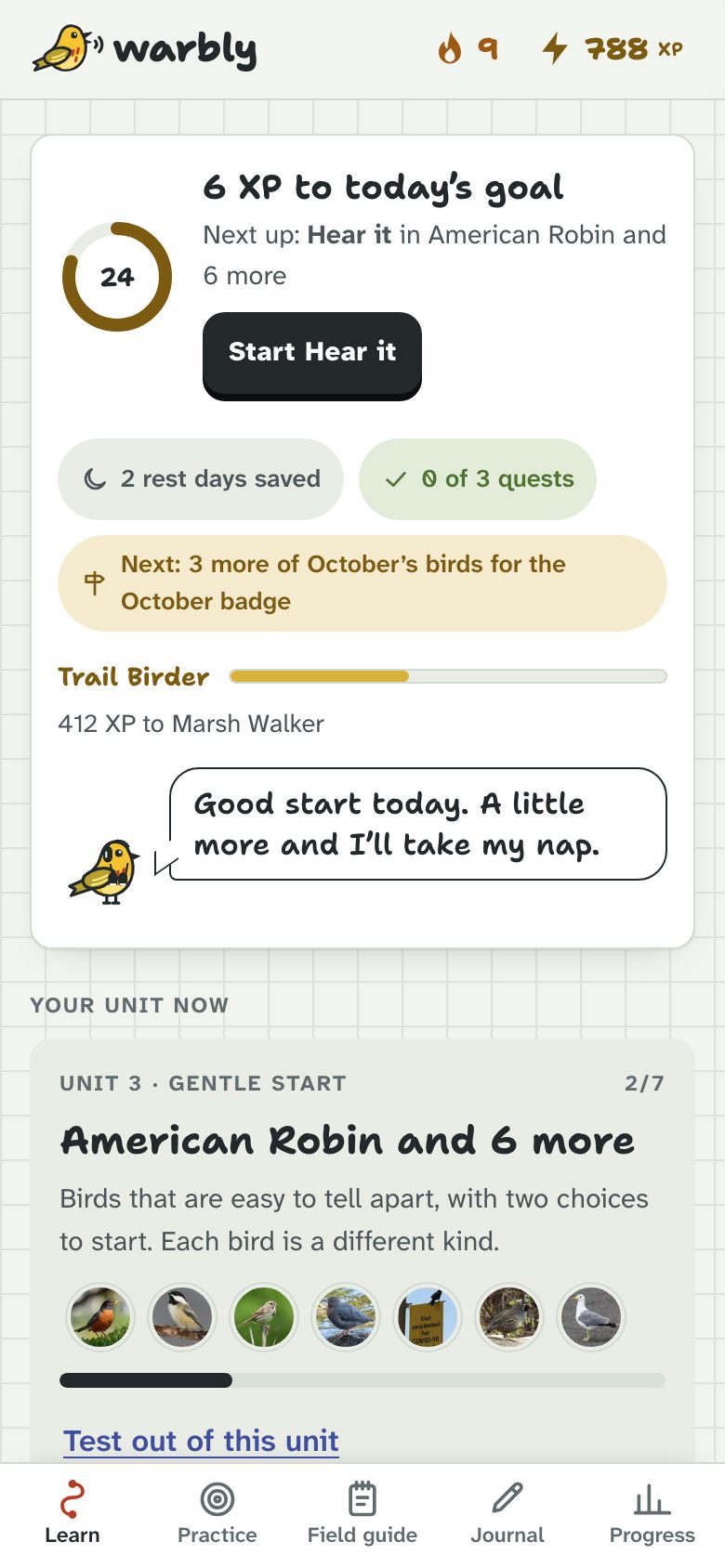
Try one now
Can you name this bird?
Three quick questions, the way Warbly asks them. No sign-up.

.jpg)
Which bird is this?
Show the answer
It’s an American Robin. Look for: brick-orange breast; gray-brown back, darker head; broken white eye-ring and yellow bill.
How it works
Three ways to know a bird
A bird you can name by its look, its song and its story is a bird you’ll know for good. Each unit is a small group of birds; you meet them, then work through the three tracks.
Spot it
Its look, and the field marks that give it away, with arrows drawn on real photos. Tap the mark on the photo to find it yourself.
Led by the Red-tailed Hawk
Hear it
Its songs and calls from real recordings, with a sonogram so you can see the sound. Slower and Lower playback help with quick, high songs.
Led by the Western Meadowlark
Know it
Where it lives, when it’s here and what it does, taken from the field guides. Short stories, never made-up facts.
Led by the Common Raven
Each unit ends with a Field test that mixes all three, led by the Killdeer. Practice brings back the birds you miss, sooner.
What you’ll do in Warbly
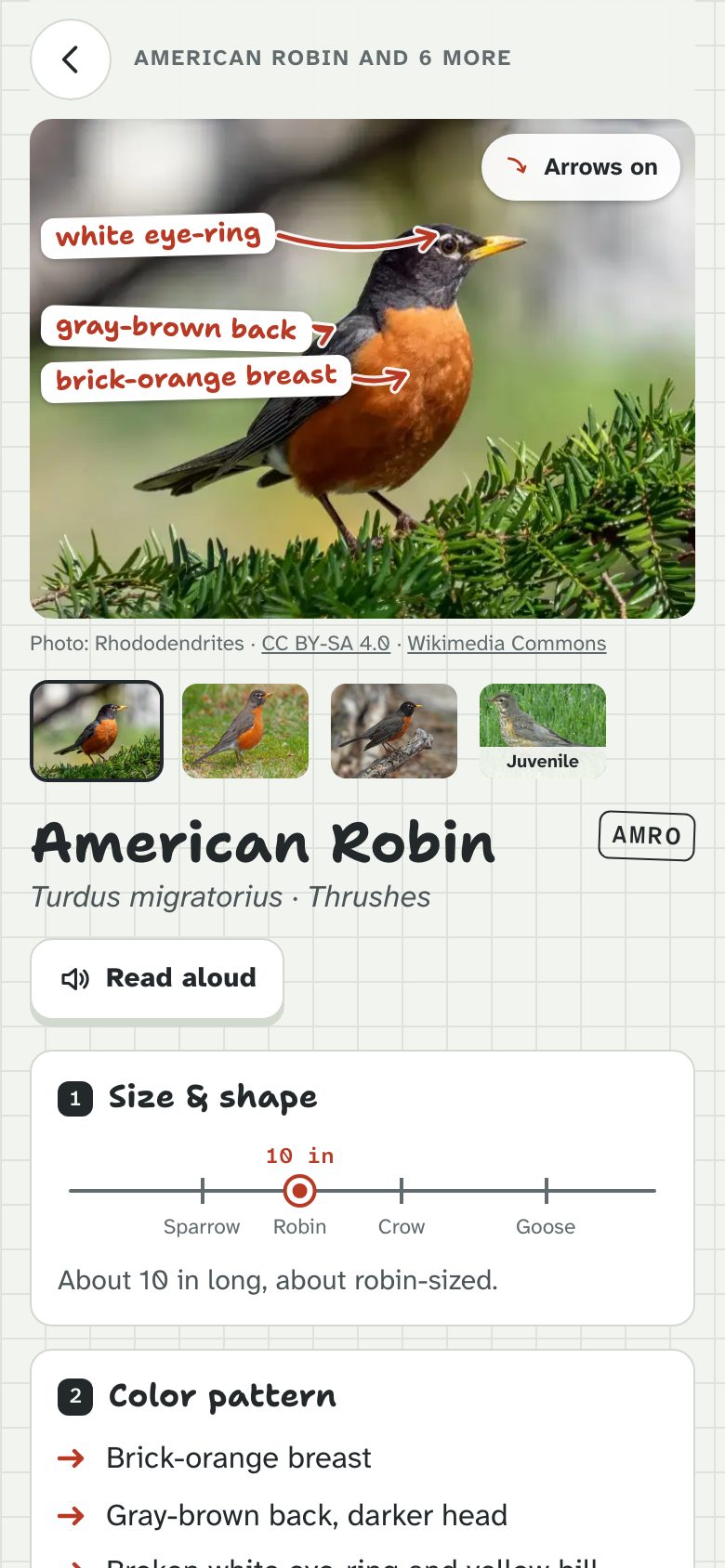
Field marks
Arrows on the photo, like a field guide
Every bird comes with the marks that tell it apart, drawn in red pencil right on a real photo. In a lesson you find them yourself: tap the brick-orange breast.
- Questions grow with you: two choices, then four, then you type the name
- Look-alikes meet each other, so the tricky pairs get easy
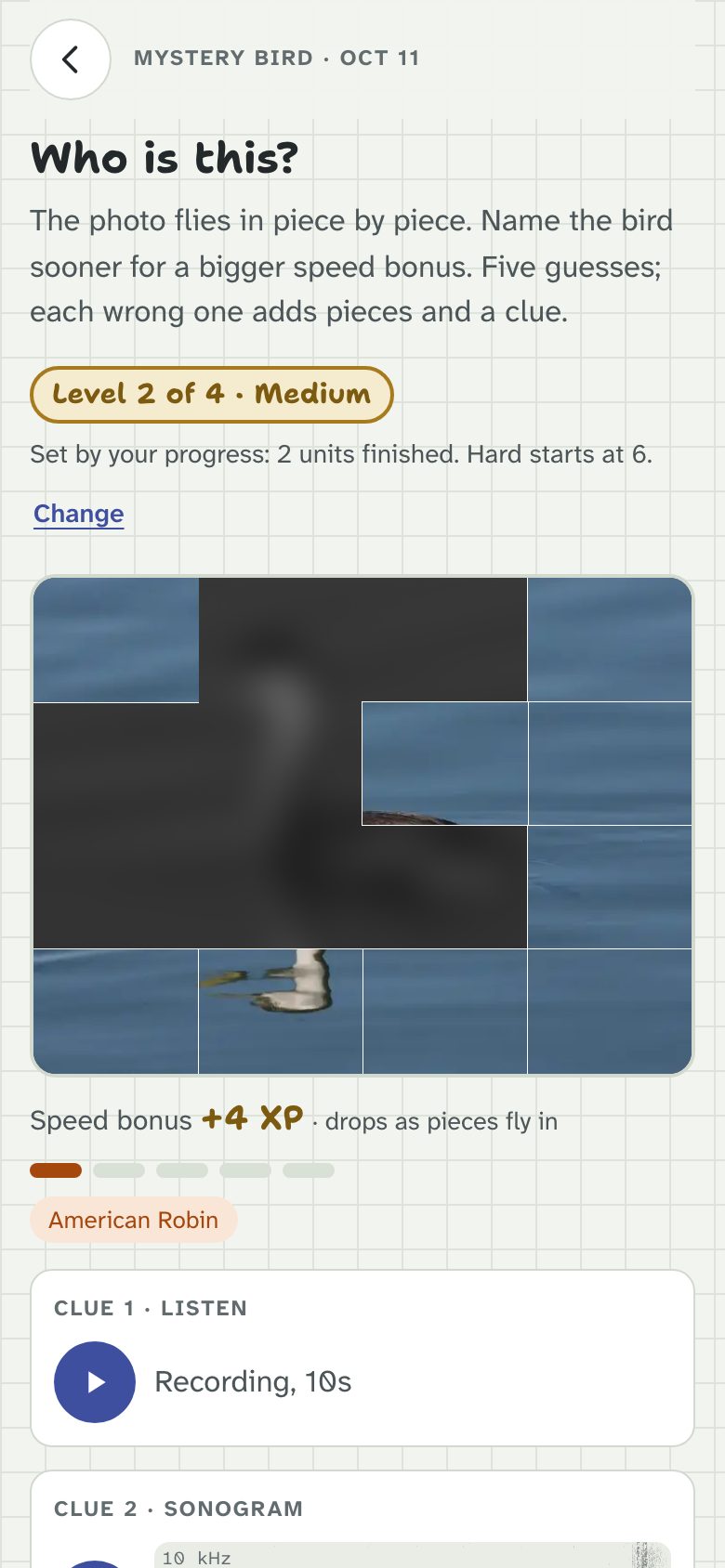
Every day
A mystery bird to puzzle out
The photo flies in piece by piece over the bird’s shadow. Name it sooner for a bigger bonus; each wrong guess brings another clue. It gets harder as you learn.
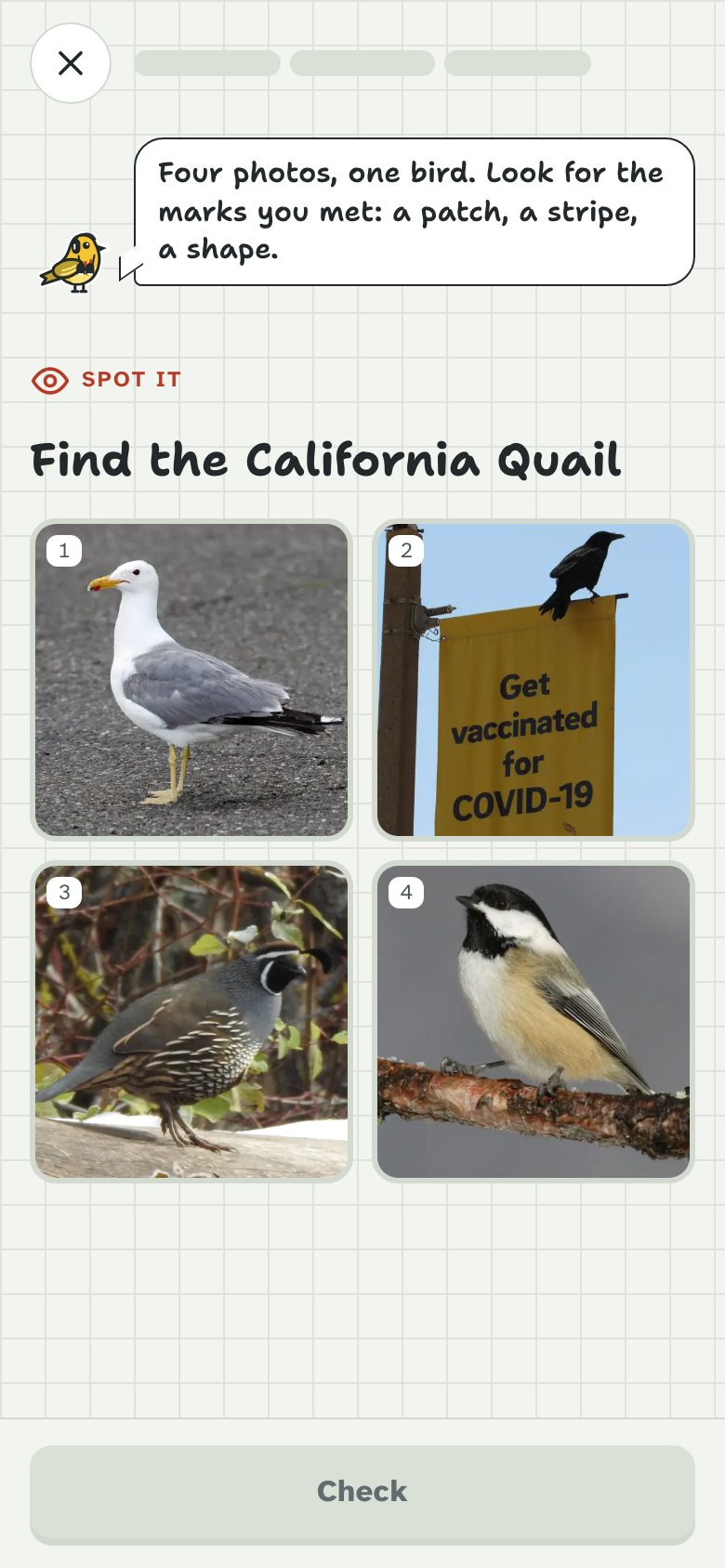
A few minutes
Lessons that fit a coffee break
Short sections, real photos and recordings, and a little celebration when you get it right. Practice brings back the birds you miss, sooner, so they stick.
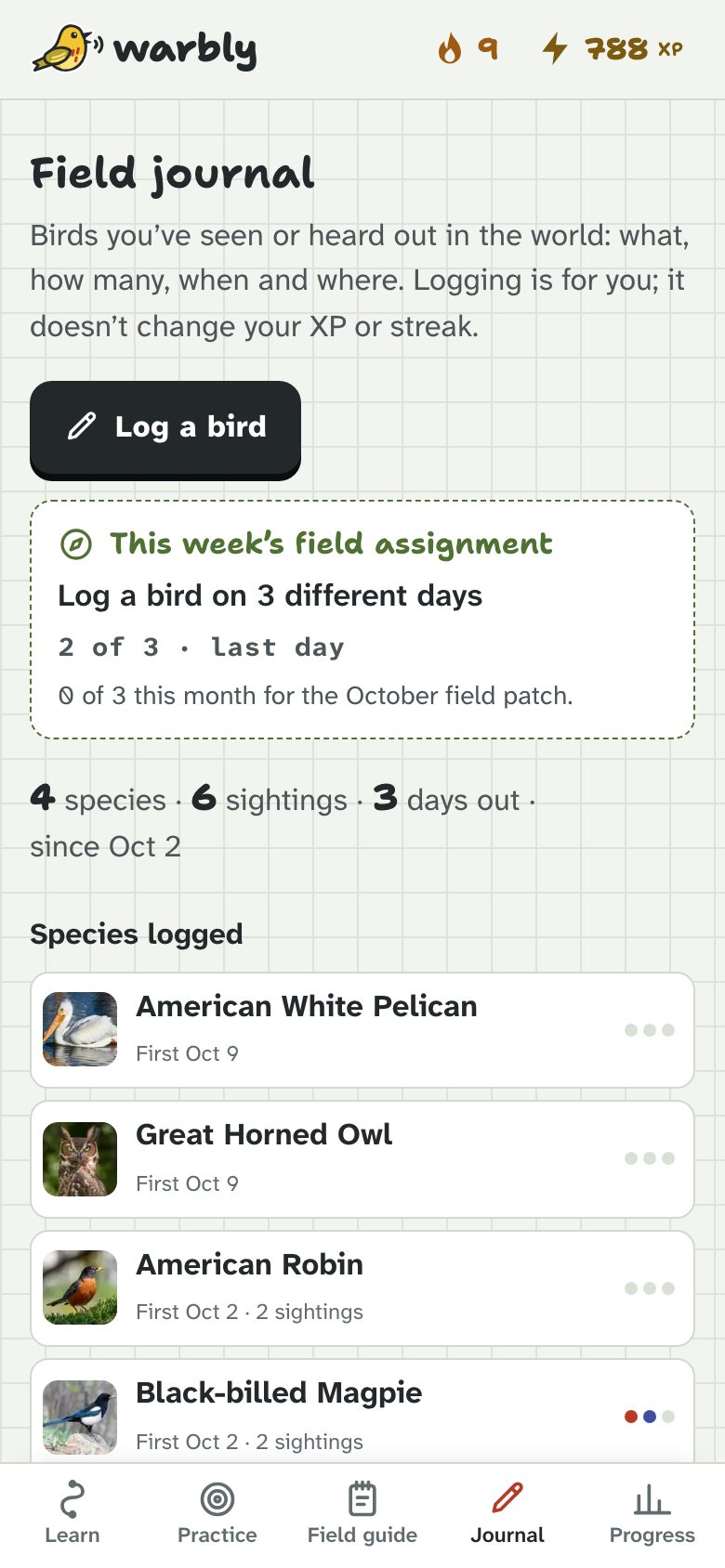
Then go find them
A field journal for real birds
Log the birds you see or hear and save them in eBird’s format to upload. Practice before the big count days, and earn a badge for logging during them.
- Print your journal as a field notebook
- Field cards that grow from a pencil sketch to watercolor and a gold edge as you learn each bird
Fun that doesn’t nag
A habit you’ll enjoy keeping
XP, ranks and streaks, gear for Warbly as you learn, and flocks to learn with friends and family. Without the guilt.
- Rest days cover a day you miss, and you can hide the streak.
- Reminders, if you want them, are about birds, never your streak.
- Earn binoculars, a field hat and more for Warbly as you know more birds.
- Flocks share a weekly goal and cheer each other on. No leagues: you compete with the birds, not each other.
No pressure. Some pressure.
Your state, your birds
A course for every state
Warbly teaches the birds you’ll actually see, picked from research-grade iNaturalist observations where you live. Each state course has 72 birds in two packs, from the backyard regulars out to the wilder places; northern Utah has an in-depth course of 103.
State shapes: US Census Bureau via us-atlas (Mike Bostock), ISC license.
Pacific Northwest
California
Desert Southwest
Great Plains
Texas
Northeast
Mid-Atlantic & Appalachians
Southeast & Gulf Coast
Alaska
Hawaiʻi
For teachers and troop leaders
Bring your class
A class with a code
Start a class and share its code. You see each student’s progress; classmates never see each other’s.
Name it together
A class game for the projector: everyone answers on their own device, and the class moves on together.
A field certificate
20 birds by sight and 5 by ear, the Bird Study merit badge’s numbers, plus a printable field notebook. It’s practice, not the badge.
Real birds, real credit
Built on the work of birders
- 411birds across the courses
- 50state courses
- 1,224real photos
- 725real recordings
Birds and seasons come from research-grade iNaturalist observations, and facts are checked against Cornell Lab’s All About Birds and Wikipedia. Every photo and recording is credited to the person who made it.
- No ads, no trackers, no analytics. Nothing about you is sold.
- Warbly never reads your location.
- No guilt: you learn at your pace.
Get it on your phone
No app store, nothing to download
Warbly runs in your browser. Add it to your home screen and it opens full screen like any other app, and works without a signal once you save the birds for offline.
iPhone and iPad
- Open app.getwarbly.com in Safari.
- Tap the Share button.
- Choose Add to Home Screen.
Android
- Open app.getwarbly.com in Chrome.
- Tap Install when it’s offered, or open the browser menu.
- Choose Install app or Add to Home screen.
On a computer?
Point your phone’s camera here to open Warbly there.

Or start in this browser. Your progress is kept on this device.
Questions
Is Warbly free?
Yes. Warbly is free to use, with no ads.
Do I have to download it?
No. Warbly is a web app, so it runs in your browser on a phone, tablet or computer. You can add it to your home screen so it opens like an app. There’s nothing to get from an app store.
Which birds will I learn?
The birds of your state: 72 per state course, in short units that start with the easiest birds and get harder as you go, with look-alikes kept in different units. They’re picked from research-grade iNaturalist observations, and each bird’s seasons come from when people there see it.
Can it tell me what bird I’m hearing?
No. Warbly teaches you to name birds yourself. Apps can tell you the bird; Warbly makes sure you know it next time. If you’ve photographed a bird, the field journal can help you name it: you guess first, then Warbly shows which of its birds match.
Do I need an account?
No. Open Warbly and start the first lesson. Your progress is saved as you go.
Does it work without a signal?
Yes, once it’s on your home screen: open Progress and choose “Save all birds for offline” to keep every photo and recording on your device.
Is it good for kids and classes?
Yes. A teacher can start a class and share a code, and classmates never see each other’s progress. There’s a class game to play on a projector, and a field certificate for 20 birds by sight and 5 by ear, the Bird Study merit badge’s numbers. It’s practice, not the badge.
What does Warbly know about me?
As little as it can. No ads, no trackers, no analytics, and Warbly never reads your location: a place in your journal is only the words you type.
Hi, I’m Warbly. I sing, you name the bird.
Your first bird is a minute away
Start with the birds on your street. Warbly does the rest, a few minutes at a time.